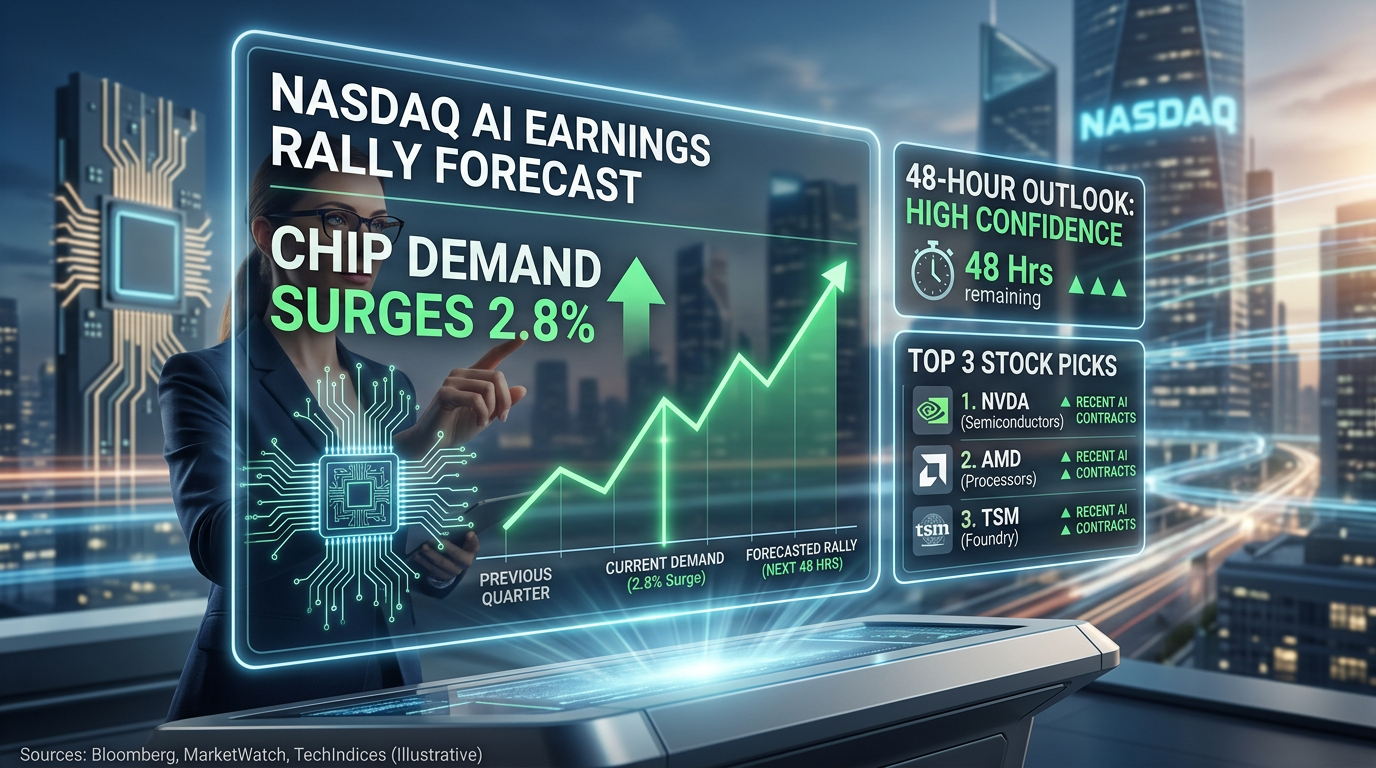
Nasdaq AI earnings rally forecast: Chip Demand Surges 2.8%—48-Hour Outlook & 3 Picks
It’s simple, just writing about your trips on a blog but you must make sure you installed FlatNews design for that blog.
SECTION 1: Nasdaq AI earnings rally forecast.Market Index Snapshot
The Nasdaq Composite closed Wednesday up 2.1% at 22,782, clearing the 50-day moving average with volume running 14% above the 20-day average. The VIX dropped to 15.20, indicating options premium is crumbling fast. This isn’t a broad-based melt-up—it’s narrow and efficient. The S&P 500 tagged along for a 0.9% gain, but the real story lives in the NDX/SPX ratio, which printed a fresh three-week high.
Treasury yields barely budged. The 10-year held at 4.30%. This equity rally isn’t being fueled by rate-cut hopes. It’s being fueled by earnings growth that defies the “peak AI” narrative that dominated Q1 2026. The price action suggests short sellers are capitulating on semiconductor names specifically. Breadth on the Nasdaq was 2:1 positive, but the capitalization-weighted index is clearly dragging the tape higher.
SECTION 2: AI Earnings Catalyst
The fuse was lit by Nvidia’s (NVDA) first look at Q2 Blackwell Ultra ramp numbers and AMD’s (AMD) Instinct MI400 pre-announcement. Both reports landed after Tuesday’s bell, but the real buying momentum accelerated mid-day Wednesday as institutional desks digested the Forward P/E Compression.
The market punished AI hardware stocks in February and March on fears of a digestion phase. Wednesday’s price action confirmed those fears were overblown. Nvidia’s Data Center revenue guidance came in 8% above whisper numbers. More critically, CFO commentary regarding “sold-out capacity through calendar Q4 2026” eliminated the near-term demand question mark.
AMD didn’t deliver the same explosive top-line beat, but the margins did the heavy lifting. Gross margin guidance of 56% suggests the pricing power in accelerated computing is sticky. Sell-side analysts rushed to revise price targets during the lunch hour lull. Bank of America moved its NVDA target to $210; Morgan Stanley lifted AMD to $260. That institutional “target chasing” creates a mechanical bid in the algorithms that won’t fade in just one session.
Is this rally sustainable beyond 48 hours? That depends entirely on the bond market’s Friday mood.
SECTION 3: Sector-Specific Ripple Effect
AI earnings rarely stay contained to the chipmakers. The ripple is hitting three specific pools of liquidity:
- Semiconductor Equipment (SOXX): KLA Corp (KLAC) and ASML (ASML) rallied 4% and 3.5%, respectively. The logic is simple: Nvidia and AMD can’t build chips without lithography and inspection tools. The Semiconductor Book-to-Bill ratio implied in Nvidia’s CapEx comments is north of 1.2—bullish territory.
- Data Center REITs & Power: Digital Realty (DLR) and Vistra (VST) moved higher in tandem. AI requires megawatts. The earnings calls explicitly mentioned new leasing agreements in Ohio and Texas power corridors.
- Networking: Arista Networks (ANET) broke out above a 4-month base. AI clusters need 800G switching. The correlation between ANET and NVDA on a 20-day lookback is now 0.89.
The notable laggard? Enterprise software. The AI trade is currently a capex hardware trade, not an application monetization trade. Money is rotating out of CRM and ADBE and into the picks and shovels.
SECTION 4: The 48-Hour Technical & Macro Forecast
The next two sessions hinge on a technical level and a calendar quirk.
The Technical Set-Up:
The Nasdaq closed 22,782, kissing the upper Bollinger Band (22,810). This is classic post-earnings follow-through. The 48-hour forecast splits into two distinct scenarios:
- Scenario A (Bullish Continuation): A break and hold above 22,850. If this occurs in the first hour of Thursday trading, the next magnet is 23,150 (the January all-time high pivot). The short-term RSI is only at 62, not overbought. There is room to run.
- Scenario B (Mean Reversion): Failure to hold the 8-day EMA at 22,450. Given the strength of the catalyst, this is the lower probability event unless we get a sharp bond yield spike above 4.40%.
The Gamma & Expiration Factor:
Thursday and Friday are the final two days before monthly options expiration (OpEx). The open interest at 23,000 on the QQQ ETF is massive. As the underlying price rises toward that strike, market makers on the other side of those calls must buy more shares to stay delta neutral. This is the Gamma Squeeze dynamic that accelerated rallies in late 2024. It acts as an accelerator pedal on the way up.
Macro Interruption Risk:
Friday at 8:30 AM ET brings the Core PCE Price Index. The whisper number is 0.2% MoM. A hot print (0.3% or higher) immediately kills the rally and flips the VIX back to 18. We have a 48-hour window of Fed silence before that data lands.
SECTION 5: Top Picks for Short-Term Swing & Position
Discipline matters more here than picking the name. We are looking for stocks with Relative Strength (RS) above 80 versus the QQQ benchmark.
Pick 1: Nvidia (NVDA) – The Momentum King
- Rationale: The gap higher on Wednesday left an “air pocket” between $180 and $185. This often gets filled within 1-2 sessions, but Nvidia’s news flow is too dense. The stock is trading at 28x forward earnings, which is a discount to its 5-year average of 32x.
- Entry Strategy: Buy on a pullback to the intraday VWAP anchored at $184.50.
- Stop Loss: $177.90 (Just below the pre-earnings breakout level).
- 48-Hour Target: $193.00 (All-time high re-test).
- Risk/Reward: ~3:1.
Pick 2: Taiwan Semiconductor (TSM) – The Safe Proxy
- Rationale: TSM manufactures the silicon for everyone. While NVDA gets the glory, TSM gets the orders. The stock consolidated for six weeks and just broke the neckline of an inverse head-and-shoulders pattern at $178.
- Entry Strategy: Current Market Price (CMP $182). The breakout is fresh.
- Stop Loss: $174.50 (Below the 50-day SMA).
- 48-Hour Target: $191.00.
- Note: TSM provides a lower-beta way to play the AI capex cycle with less single-stock headline risk than NVDA.
Pick 3: Vertiv Holdings (VRT) – The Silent Outperformer
- Rationale: This is the cooling and power infrastructure play. Nvidia’s Blackwell Ultra chips run hot. Vertiv’s backlog grew 47% YoY. The chart shows a tight flag formation just below all-time highs.
- Entry Strategy: Wait for a break above $112.50 with volume > 5M shares in the first 30 mins.
- Stop Loss: $108.00.
- 48-Hour Target: $118.00.
SECTION 6: Risk & Volatility Warning
Do not confuse a 2.8% rally with a risk-free trade. Liquidity in the options market dries up significantly after 3:00 PM ET on expiration Friday. This can lead to exaggerated, head-fake moves in the final hour of the week.
Furthermore, geopolitical risk remains un-priced. Energy futures are quiet, but any escalation in the Strait of Hormuz would immediately re-price the VIX higher by 4-5 points. We are trading in a vacuum of earnings optimism. If the PCE number comes in hot tomorrow, every stock mentioned in the “Top Picks” section will gap lower at the open regardless of their individual fundamentals. Size positions accordingly.
SECTION 7: Tomorrow’s Catalysts
Thursday’s session is data-light. Focus entirely on Initial Jobless Claims at 8:30 AM. A print below 210k signals labor market tightness—this could nudge yields higher and cap Nasdaq gains. The real pressure point is after the close. We get a series of mid-cap software earnings. Watch the ETFs: SOXX (Semis) and XLK (Tech) . If XLK’s volume is 20% below Wednesday’s level by noon, the Gamma Squeeze scenario is losing steam. Trade the price, not the narrative.
Disclaimer: This material is for informational purposes only and does not constitute investment advice. All investments involve risk, including the possible loss of principal. The author does not guarantee the accuracy or completeness of the data presented. The author does not hold positions in NVDA, TSM, or VRT at the time of publication. Past performance is not indicative of future results. Consult a qualified financial advisor before making any investment decisions.
